

Is Spinal Cord Stimulation Right for You?
Spinal cord stimulation (SCS) can be an effective treatment for chronic pain, especially for individuals who haven’t found relief through other methods. At Inovo Spine, Dr. Pawan Grover specializes in evaluating whether spinal cord stimulation is the right solution for your pain management needs. Using advanced techniques, we work with each patient to understand their unique pain patterns and provides personalized recommendations. For more information, contact us or book an online appointment. We are conveniently located at 1140 Business Center Dr, Suite 110, Houston TX 77043.
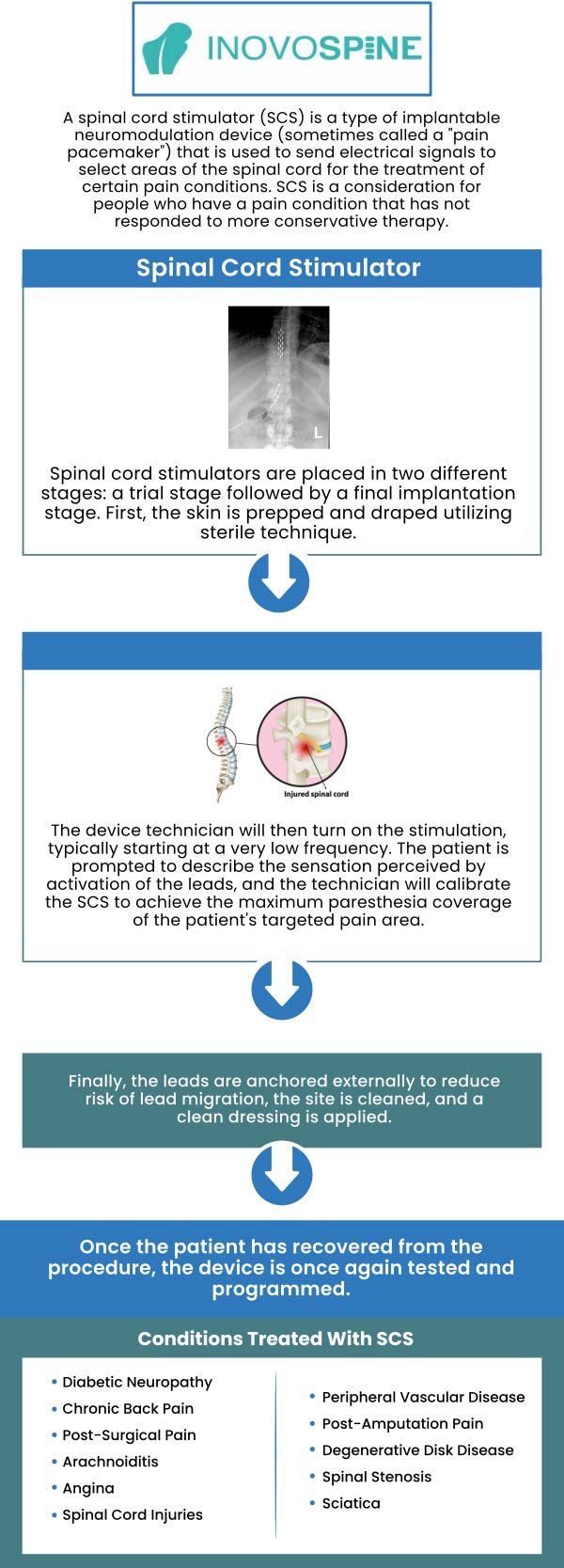
Table of Contents:
What types of chronic pain conditions can spinal cord stimulation (SCS) help treat?
How does spinal cord stimulation work to reduce pain signals?
Am I a good candidate for SCS if medications or injections haven’t worked?
Is spinal cord stimulation recommended for patients with failed back surgery syndrome?
Find out with Dr. Grover: Determining your candidacy for spinal cord stimulation in Houston
Spinal cord stimulation is a proven treatment option for a variety of chronic pain conditions, especially those involving neuropathic pain — pain that arises from nerve irritation, damage, or dysfunction. Patients with pain that has persisted for months or years, despite traditional therapies, may benefit from SCS. Some of the most common conditions for which SCS is used include:
Pain that persists after spinal surgery, often referred to as failed back surgery syndrome (FBSS) Pain radiating down the arms or legs due to radiculopathy or nerve compression Chronic lower back pain that has not responded to physical therapy or injections Pain caused by peripheral neuropathy, such as diabetic nerve pain Complex regional pain syndrome (CRPS), a condition characterized by severe, burning pain and sensory abnormalities Chronic pain from vascular insufficiency or ischemic limb pain.
SCS may also help patients with certain types of refractory pain — pain that has been resistant to multiple treatments over time. The goal is not necessarily to eliminate all pain (which is not always possible) but to significantly reduce pain intensity, improve function, and enhance quality of life.
Spinal cord stimulation works by interrupting the pain signals that travel from the nerves in your spinal cord to the brain. The nervous system communicates through electrical impulses, and chronic pain often arises when these impulses become overactive or misinterpreted by the brain.
During SCS therapy, thin wires called electrodes are placed near the spinal cord in the epidural space through a minimally invasive procedure. These electrodes are connected to a small pulse generator — often referred to as a “stimulator” — that delivers gentle electrical pulses.
The electrical pulses don’t stop pain entirely; instead, they modify the way pain signals are processed by the spinal cord and brain. Many patients describe the sensation as a pleasant tingling (called paresthesia) that replaces or masks the pain. Because the nervous system is being modulated rather than chemically suppressed, SCS can provide relief without the side effects associated with long-term opioid use or high-dose oral medications.
The mechanism of action also means that spinal cord stimulation can be adjusted over time. Settings can be programmed to match your changing pain patterns, activity level, and daily needs. Advances in SCS technology now include paresthesia-free stimulation and closed-loop systems that dynamically adjust based on nerve signals.
Not every patient with chronic pain is automatically a candidate for spinal cord stimulation, but many people whose pain has not responded to conservative measures are appropriate candidates for evaluation.
A good candidate for SCS typically has:
• Chronic pain lasting six months or more despite trying multiple treatments
• Pain that is mainly neuropathic in nature — burning, shooting, electric-like, or tingling pain
• Limited relief from medications, physical therapy, or pain injections
• No significant untreated psychological conditions that could interfere with SCS outcomes
Before recommending a permanent implant, most pain specialists will first offer a temporary trial of spinal cord stimulation. During the trial, temporary leads are placed, and you wear an external stimulator for about a week. If you experience meaningful improvement — often defined as at least a 50% reduction in pain and better function — this is a strong indicator that a permanent system could be beneficial.
It is also important for candidates to understand that spinal cord stimulation is part of a comprehensive pain management plan. It works best when combined with physical therapy, activity pacing, lifestyle changes, and ongoing support from a pain specialist team.
Yes — spinal cord stimulation is one of the most commonly recommended advanced treatments for patients with failed back surgery syndrome (FBSS). FBSS is a term used when a patient continues to experience significant back or leg pain after one or more spinal surgeries. This pain can be due to nerve irritation, scar tissue formation, recurrent disc herniations, or altered nerve signaling following surgery.
Traditional approaches like additional surgery, medication adjustments, and repeated injections often provide only temporary or partial relief. Spinal cord stimulation targets the nerve signaling pathways directly, offering a different mechanism of action that can provide sustained relief when other options have been exhausted.
Several studies and clinical guidelines support the use of SCS for FBSS, showing improvements in pain levels, physical function, and overall quality of life. Many patients report they are able to reduce pain medication doses and return to activities they had stopped due to pain.
Deciding whether spinal cord stimulation is right for you should be a personalized process guided by a specialist with expertise in both conservative and advanced pain therapies. At Inovo Spine & Pain, Dr. Grover and our multidisciplinary team take a thorough, evidence-based approach to evaluating your pain history, diagnostic imaging, previous treatments, and overall health goals.
The evaluation typically includes:
• A comprehensive review of your medical history and pain pattern
• Physical examination to assess functional limitations and neurological status
• Diagnostic imaging as needed (MRI, CT scans) to understand spinal and nerve structures
• A discussion of realistic expectations and the potential benefits and risks of SCS
• A trial stimulation period to measure how well SCS affects your pain in daily life
Your treatment plan is tailored to your individual needs. For many patients, spinal cord stimulation is a transformative step toward regaining control, reducing reliance on medications, and improving overall function.
If you’ve tried multiple treatments and are still living with persistent pain, scheduling an evaluation with a specialist like Dr. Grover is the next step toward finding effective relief. Spinal cord stimulation is not a universal solution, but for the right candidate, it can be life-changing. For more information, contact us or book an online appointment. We are conveniently located at 1140 Business Center Dr, Suite 110, Houston TX 77043. We serve patients from Houston TX, Hedwig Village TX, Meadows Place TX, Missouri City TX, Hunters Creek Village TX, Spring Valley Village TX, and surrounding areas.

Additional Service You May Need
- Regenerative Medicine
- Spinal Arthritis
- Diagnostic Mapping
- Interventional Pain
- Minimally Invasive
- Spine Pain
- Radiofrequency Ablation
- Spinal Cord Stimulation
- Physical Rehabilitation
- Facet Joint Pain
- Herniated Discs
- Muscle and Joint Pain
- Post-Laminectomy Pain
- Myofascial Pain
- Peripheral Nerve Pain
- Regional Pain Syndrome






 Send Text
 How May I Help You?